Best Silicone 3D Printer Filament for Flexible and Durable Printing
Finding the right filament for 3D printing flexible objects requires balancing elasticity, durability, and printer compatibility. Silicone-like filament options offer excellent softness while maintaining strength, making them perfect for projects demanding flexibility and resilience. Below is a comparison table summarizing the top silicone and TPU filaments available on Amazon, highlighting key features such as Shore hardness, printability, and flexibility. This guide will help you choose the best filament suited for your 3D printing needs.
| Product | Brand | Shore Hardness | Flexibility | Dimensional Accuracy | Weight |
|---|---|---|---|---|---|
| SUNLU TPU 3D Printer Filament 1.75mm (Black) | SUNLU | 95A | High Speed Flexible Printing | +/- 0.03mm | 1kg |
| FLASHFORGE PLA Flexible 1.75 mm | FLASHFORGE | Not Specified | 4X Original Length Stretch | +/- 0.02mm | 1kg |
| 3Dmate 3D Pen Filament Kit with Silicon Mat | 3Dmate | Not Applicable | Soft 3D Doodling Filament | 1.75mm standard | 360 Feet assorted |
| OVERTURE TPU Filament 1.75mm Flexible Roll (Black) | OVERTURE | 95A | High Durability and Flexibility | +/- 0.03mm | 1kg |
| Geeetech TPU Filament 1.75mm Clear | Geeetech | 95A | High Elasticity & Wear-Resistant | +/- 0.03mm | 1kg |
SUNLU TPU High Speed Flexible 3D Printer Filament

SUNLU TPU Filament features a Shore hardness of 95A, delivering an ideal balance of softness and resilience. It boasts high-speed printing capabilities, up to three times faster than standard TPU filaments, making it suitable for flexible projects requiring efficiency. Designed with excellent layer adhesion, this filament ensures smooth finishes and durable bonding between layers. Its thermoplastic polyurethane material provides resistance to impacts and wear, perfect for robotics, fashion, and sports applications. The filament maintains dimensional accuracy within +/- 0.03mm, suitable for most FDM 3D printers.
FLASHFORGE PLA Flexible 1.75mm, Stretchy 3D Printer Filament
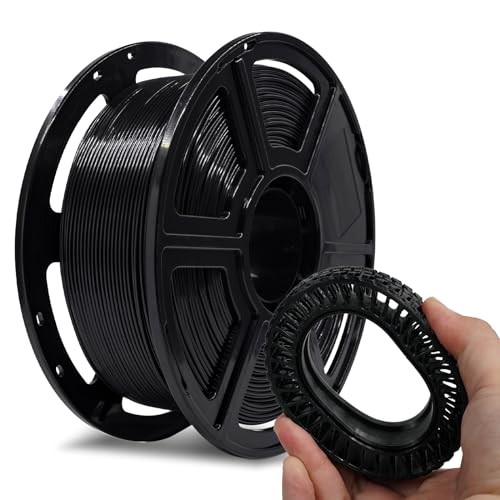
This filament from FLASHFORGE offers superior elasticity compared to TPU, stretching up to four times its original length. Ideal for printing soft accessories like insoles, belts, and phone cases. It supports both Bowden and direct drive extruder printers, though minor adjustments may be needed for Bowden setups. The filament is vacuum-sealed and pre-dried for better print quality, limiting bubbles and clogs. Its dimensional accuracy is reported at +/- 0.02mm, providing consistent output suitable for beginners and advanced users focusing on flexible projects.
3Dmate 3D Pen Filament Kit with Silicon Design Mat

The 3Dmate 3D Pen Filament Kit includes 360 feet of assorted PLA filament, designed for 3D drawing and crafting rather than traditional printing. Its highlight is the heat-resistant silicone design mat, which aids precise filament shaping and easy removal of cooled pieces. The kit incorporates a stencil book with 11 templates for creative projects and finger protectors for safety. While PLA differs from TPU in elasticity, this kit offers bright colors and broad 3D pen compatibility for artistic flexible creations.
OVERTURE TPU Filament 1.75mm Flexible Roll

OVERTURE’s TPU filament combines durability and flexibility, with a Shore hardness of 95A suitable for versatile flexible parts. The filament features patented clog-free formulation that prevents jams and bubbles, complemented by vacuum packaging and 24-hour pre-drying to maintain optimal performance. Its excellent layer adhesion produces smooth, resilient prints fit for functional applications like robotics and wearable items. Dimensional accuracy is consistent at +/- 0.03mm, ensuring compatibility with most FDM printers.
Geeetech TPU Filament 1.75mm Flexible and Durable

The Geeetech TPU filament is crafted from high-elasticity TPU material with a Shore hardness near 95A, balancing flexibility and wear resistance. This filament withstands daily impacts and stretching, ideal for phone cases, insoles, and flexible toys. Featuring a patented clog-free formula, 24-hour drying, and vacuum-sealed packaging with desiccants, it minimizes printing issues. Strong layer adhesion produces smooth finishes without delamination. The spool offers dimensional accuracy of ±0.03mm, supporting reliable, high-quality flexible printing for both beginners and professionals.
Buying Guide For Silicone And Flexible 3D Printer Filaments
Choosing the best silicone-like filament for your 3D printer depends on several factors. Understanding these can enhance your printing experience and product functionality.
- Material Type and Shore Hardness: TPU filaments are common for flexible applications and usually rated on Shore hardness. A Shore hardness of around 95A strikes balance between softness and toughness, suitable for wearables and flexible parts. Softer filaments (lower Shore rating) are stretchier but may be harder to print consistently.
- Print Speed and Compatibility: Some TPU filaments, like SUNLU’s high-speed variant, can print up to three times faster than standard filaments. Check compatibility with your printer’s extruder type (Bowden vs direct drive) as flexible filaments may need adjustments to avoid jams.
- Dimensional Accuracy and Consistency: Reliable filament diameter tolerance (+/- 0.02mm to 0.03mm) reduces clogging and improves print quality. Vacuum-sealed packaging and pre-drying also prevent moisture-induced problems.
- Layer Adhesion and Surface Finish: Filaments with excellent layer bonding technology minimize print defects like delamination and achieve smooth surface finishes, improving durability of flexible prints.
- Flexibility and Elasticity: Consider the filament’s stretch potential. Flexible PLA variants provide good elasticity for decorative or soft utility items but offer less durability than TPU-based filaments.
- Additional Accessories: Some kits come with helpful tools like silicone mats and stencils, useful for precision 3D pen drawing and doodling projects.
- Heat Resistance: For some applications, filaments that tolerate higher temperatures during printing and use can enhance final product wear and longevity.
By evaluating filament softness, printability, and your project requirements, you can select the ideal silicone 3D printer filament that balances flexibility, strength, and ease of use.