Best ESD Safe 3D Printer Filaments for Electronics and Functional Printing
When working on electronics or sensitive equipment models, using an ESD safe 3D printer filament is crucial to prevent electrostatic discharge damage. This article reviews some of the top 3D printer filaments offering ESD protection, durability, and printability to help you choose the right material for your projects. Below is a summary table highlighting key features for quick comparison.
| Product Name | Brand | Material Type | ESD Safe | Spool Weight |
|---|---|---|---|---|
| Polymaker Fiberon PETG-ESD Filament | POLYMAKER | PETG with Nano Carbon Tube | Yes | 0.5 kg |
| Reprapper Electrically Conductive PLA Filament | RepRapper | Conductive PLA | Yes | 1 kg |
| Certified Food Grade PLA+ Carbon | CARBON | PLA+ (Food Safe) | No | 1 kg |
| Silver (Ag) Certified Food Grade PLA+ Anti-Bacterial | CARBON | Anti-Microbial PLA+ | No | 1 kg |
| OVERTURE PLA Filament | OVERTURE | PLA | No | 1 kg |
Polymaker Fiberon PETG-ESD Filament 1.75mm Black

Polymaker Fiberon PETG-ESD filament features a nano carbon tube technology integrated into PETG, making it perfectly electrostatic discharge safe. This filament is designed for electronics applications requiring conductivity protection. It offers excellent printability, heat resistance, and strength. Compatible with most mainstream and entry-level 3D printers, it promotes an efficient and high-speed printing experience. Its toughness and durability make it a versatile choice for functional prototyping, jigs, fixtures, and electronic housings where ESD safety is critical.
Reprapper Electrically Conductive PLA Filament 1.75mm Black

This conductive PLA filament by RepRapper is enhanced with graphene and carbon, granting it electrical conductivity suitable for projects with ESD functionality. While it won’t match copper wire’s conductivity, it is ideal for printing 3D circuits, sensors, switches, and electronic device covers. Raw materials include USA Natureworks Ingeo 4032d PLA, ensuring material quality. Conductivity varies depending on infill and model design, making it appropriate for research and detailed electronic applications needing static discharge protection and conductive properties.
Certified Food Grade PLA+ 3D Printer Filament – CARBON Blue
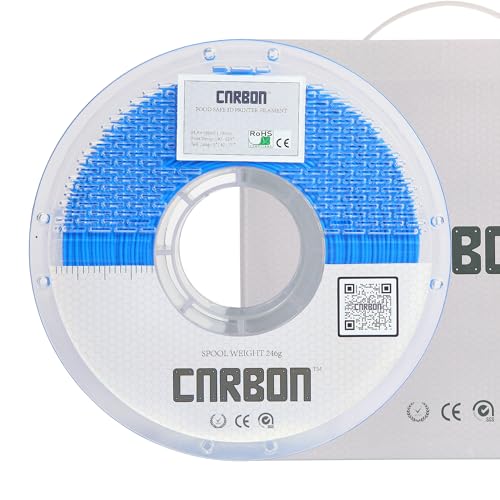
The CARBON Certified Food Grade PLA+ filament offers FDA-compliant safety for food contact. Though not ESD safe, its lab-tested, high-quality PLA+ resin ensures smooth and reliable printing with tight dimensional accuracy (+/- 0.02mm). This filament suits users prioritizing environmental friendliness and food safety for 3D printing functional parts or containers that require certification compliance. It excels in consistency and ease of printing across various models.
Silver (Ag) Certified Food Grade PLA+ Anti-Bacterial – CARBON Natural

CARBON’s Silver (Ag) PLA+ filament is an anti-microbial composite that reduces bacterial growth by 99.9%, certified food grade and lab tested per FDA regulations. The silver additive helps maintain internal sterility in bio-based PLA+. While not ESD safe, it is suitable for projects requiring hygienic surfaces and environmental safety. The filament maintains smooth extrusion with tightly controlled dimensions, ideal for medical or food-related applications.
OVERTURE PLA Filament 1.75mm White 1kg

The OVERTURE PLA filament exhibits exceptional dimensional accuracy (+/- 0.02mm) and consistent quality. Though it does not offer ESD protection, the filament ensures clog-free and smooth printing performance with bubble-free extrusion. Vacuum-sealed packaging preserves filament quality, and the thicker inside diameter of the spool promotes easy feeding and less tangling. This PLA is suitable for general 3D printing needs requiring reliability and material consistency.
Buying Guide for ESD Safe 3D Printer Filament
Choosing the right ESD safe filament depends on your specific 3D printing application. Consider the following factors to make an informed decision:
ESD Protection Level
- Conductivity Requirements: Assess the level of electrostatic discharge protection needed. Materials with embedded conductive carbon or graphene provide varying conductivity. For sensitive electronics, choose proven ESD safe filaments with lab validation.
- Application Environment: Confirm the filament’s suitability for dry or humid environments, as moisture can affect conductivity and print stability.
Material Compatibility & Printer Use
- Printer Compatibility: Most filaments listed here support standard 1.75mm diameter extruders. Verify your printer’s specifications for PETG or PLA+ compatibility.
- Printing Temperature & Bed Requirements: PETG-ESD filaments typically require higher extrusion temperatures (~230-250°C) compared to PLA variants (~190-220°C). Ensure your printer can maintain stable settings.
Mechanical & Functional Properties
- Strength and Durability: PETG-based ESD filaments offer more toughness and heat resistance compared to PLA, suitable for functional parts exposed to stress or heat.
- Print Precision: Dimensional accuracy (+/- 0.02mm) contributes to better fit and finish, critical for electronic enclosures and prototyping.
Additional Features
- Food or Medical Safety: If your work overlaps with food or medical applications, consider FDA-certified PLA+ options with anti-microbial additives, although these may lack ESD properties.
- Environmental Impact: PLA variants are bio-based and eco-friendlier but may be less durable. Balance sustainability with project demands.
By weighing these comparisons—conductivity, printability, mechanical strength, and safety certifications—you can select the best ESD safe filament tailored to your 3D printing needs.