Best Industrial 3D Printers for Professional Design and Manufacturing
Industrial 3D printers are essential tools for professionals seeking precision, speed, and versatility in their manufacturing and design processes. They offer advanced features such as large build volumes, high-speed printing, auto-leveling, and durable construction suited for demanding environments. Below is a summary table featuring top-tier industrial-grade 3D printers and accessories, which excel in industrial design applications.
| Product | Brand | Main Features | Build Volume |
|---|---|---|---|
| Snapmaker Artisan Dual Extruder 3D Printer | Snapmaker | 3-in-1 modular functions, dual extrusion, linear rails, large touchscreen | 15.75″ x 15.75″ x 15.75″ |
| QIDI MAX3 High-Speed 3D Printer | R QIDI TECHNOLOGY | 600mm/s speed, CoreXY structure, fully auto-leveling, handles specialty filaments | 12.8″ x 12.8″ x 12.4″ |
| Crafit 3D Printer Enclosure Cabinet | Crafit | Wide compatibility, ventilation system, thermo-hygrometer, noise reduction | Compatible with large printers up to 21.6″ W x 22″ D x 28.7″ H |
| FLASHFORGE AD5M Pro 3D Printer | FLASHFORGE | High-speed CoreXY, full auto calibration, HEPA filtration, quiet printing | Not specified (desktop size) |
| 3D Printers TINA2Plus V2 | Entina | High-speed 250mm/s, spring steel platform, WiFi connectivity, beginner-friendly | Not specified (mini size) |
Snapmaker Artisan Dual Extruder Industrial 3D Printer

The Snapmaker Artisan is a versatile industrial-grade 3D printer designed to offer multiple fabrication functions through a modular system, including 3D printing, laser engraving, cutting, and CNC carving (note this model is 3D printing only). It features a large build area of 400mm³ (15.75″³), which accommodates sizable and complex industrial projects without taking up excessive space.
Its standout feature involves dual extrusion technology combined with planetary gears for precise filament feeding and improved printing speed. The robust all-metal body and industrial linear rails contribute to performance stability, while the 7″ touchscreen enables easy operation and settings management. This printer caters to professional applications requiring both precision and workspace efficiency.
QIDI MAX3 High-Speed Large Format 3D Printer

The QIDI MAX3 excels in speed and large-volume printing with a maximum nozzle speed of 600mm/s and an acceleration of up to 20,000mm/s², making it one of the fastest industrial 3D printers at this scale. The large 325mm x 325mm x 315mm build volume supports extensive prototyping and production tasks.
Its CoreXY mechanical structure ensures solid frame stability, supported by hardened steel linear shafts and a 6mm aluminum heatbed plate, minimizing maintenance needs over long-term use. The printer supports a wide range of filaments including carbon fiber-reinforced and high-temperature materials, offering versatility in industrial-grade material experimentation. The direct drive extruder further enhances material compatibility.
Crafit Industrial 3D Printer Enclosure Cabinet

This industrial-grade cabinet is designed to improve print quality by stabilizing environmental factors during 3D printing. Its spacious interior fits popular large 3D printers like the Bambu Lab series and Ender models. The enclosure offers heat resistance and noise reduction up to 40%, essential for high-speed and high-temperature printing processes.
The integrated ventilation system along with a thermo-hygrometer continuously monitors and maintains optimal humidity and temperature, thereby reducing risks like warping. Its sturdy construction using stainless steel and acrylic panels ensures durability and quiet operation, making it an ideal companion for professional workshop settings.
FLASHFORGE AD5M Pro High-Speed 3D Printer with HEPA Filter

The FLASHFORGE AD5M Pro is a quiet, fully enclosed 3D printer that blends speed with safety and reliability. With speeds up to 600mm/s, this model uses a CoreXY structure for precise movement and rapid prototyping efficiency. Its automatic bed leveling system ensures consistently perfect first layers.
Safety features include a dual filtration system with HEPA13 and activated carbon filters that capture 99% of particulate emissions, making it suitable for office or classroom environments. The unit is designed to operate quietly (<50 dB), facilitating focused work sessions without noise disturbance.
Entina TINA2Plus V2 High-Speed Mini 3D Printer
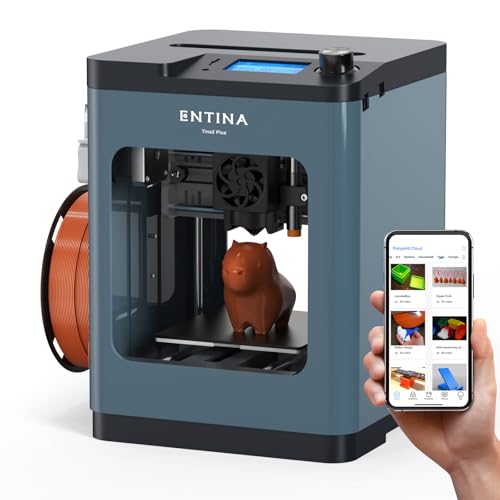
The Entina TINA2Plus V2 brings industrial speed to a compact form factor, featuring a printing speed of 250mm/s. It uses a spring steel platform which enhances adhesion and facilitates easy model removal, making it user-friendly and stable in performance.
This fully assembled printer supports WiFi printing and comes equipped with an extensive starter kit including slicing software and designed models, targeting beginning users and educational applications. Despite its small size, it offers high precision with fast heat dissipation thanks to a powerful fan system, suitable for quick prototyping and design testing scenarios.
Buying Guide for Industrial 3D Printers
Choosing the right 3D printer for industrial design depends on multiple factors. This guide highlights key considerations to navigate your choice effectively.
Build Volume and Work Area
- Project Size: Larger build areas accommodate bigger prototypes or multiple parts per print, enhancing productivity.
- Workspace Constraints: Balance between printer size and available workspace is essential to optimize your setup.
Printing Speed and Precision
- High-Speed Printing: Industrial printers often reach speeds above 200mm/s, reducing turnaround time.
- Precision: Features like linear rails and dual extrusion gears improve dimensional accuracy and surface finish.
Material Compatibility
- Select printers that support a wide range of industrial filaments such as ABS, PETG, carbon fiber composites, and specialty materials for functional prototyping.
- Direct drive extruders generally provide better control for flexible and composite filaments.
Automation and Ease of Use
- Auto bed leveling simplifies setup and increases printing reliability.
- Touchscreens and connectivity options (WiFi, cloud printing) enhance workflow efficiency.
Environmental Controls
- Enclosures, ventilation, and filtration systems improve print quality by stabilizing temperature and reducing harmful particulate emissions.
- Noise reduction features are critical for maintaining comfortable working environments.
Maintenance and Longevity
- Choose durable frames and components to reduce downtime caused by repairs or part replacements.
- Modular designs allow upgrades such as multi-function tool heads for laser engraving or CNC carving.
Evaluating these aspects will help you select an industrial 3D printer that aligns with your professional design requirements and operational workflow.